It's been a while since I opened blogger for any reason other than deleting spam comments, but I've just come out of Ad Astra and I need to talk about it. No... I need to write about it.
I blame grad school and film class for this.
I love a good sci-fi movie as much as the next nerd. I've seen every Star Wars film (that was released in my lifetime) in a theater, I've enjoyed plenty of Star Trek, I laughed and cried in The Martian, and I'm a sucker for time travel (except for The Time Traveler's Wife, that movie scarred me for life, please do not watch it, watch About Time instead). I would argue, however, that Ad Astra is not a sci-fi movie; it is a movie that uses sci-fi tropes to explore modern ideas of religion, mental health, and resource allocation.
Be warned, heavy spoilers lie beyond the jump.

Sunday, October 6, 2019
Sunday, March 25, 2018
A Palm Sunday Prayer
Today is Palm Sunday and I have been meditating on the significance of Christ's entry into Jerusalem. I have read that in eastern traditions, a king who rode into a city on a horse was declaring an act of war, or triumphantly claiming a defeated city which he had won through blood and battle. The donkey, in that same tradition, was meant to be the opposite. A king who enters a city on his donkey is declaring peace, not war.
On Palm Sunday, Jesus entered Jerusalem on a donkey. He declared his intentions for peace. The people shouted Hosannas and psalms, waving palm leaves and celebrating Him. He did not ask his followers to wield weapons, and even when Peter raised a sword against a man at the betrayal a few days later, Christ healed the man before doing anything else.
On Palm Sunday, Jesus entered Jerusalem on a donkey. He declared his intentions for peace. The people shouted Hosannas and psalms, waving palm leaves and celebrating Him. He did not ask his followers to wield weapons, and even when Peter raised a sword against a man at the betrayal a few days later, Christ healed the man before doing anything else.

Thursday, October 26, 2017
My Sorrow
Author's Note: This post is about miscarriage. If that's not a thing you can read about, you should probably skip it.
First things first: Thank you.
It may not be fair to claim, but I think my baby was the most celebrated and loved baby in its short weeks of life in utero. Friends and family alike cheered me on, gave better hugs, and spoiled me with mermaid tail blankets, candy, and quality time.
First things first: Thank you.
It may not be fair to claim, but I think my baby was the most celebrated and loved baby in its short weeks of life in utero. Friends and family alike cheered me on, gave better hugs, and spoiled me with mermaid tail blankets, candy, and quality time.
Saturday, September 30, 2017
God Didn't Do This To Me.
Well, it's #LDSconf weekend and Mormon Twitter is out in full force, tweeting how spiritual everything is, and occasionally calling out crap we hear from the pulpit (*coughcoughOakscough*).
But those aren't the kinds of talks I want to talk about. There are some other talks that sit somewhere in between. That make me uncomfortable because of their content but that are not necessarily out of harmony with how most Mormons understand the Gospel. I know that my own understanding is limited, and I'm willing to admit that perhaps I am wrong about this, but I'm gonna throw it out there anyway: I don't think God designed my pain.
But those aren't the kinds of talks I want to talk about. There are some other talks that sit somewhere in between. That make me uncomfortable because of their content but that are not necessarily out of harmony with how most Mormons understand the Gospel. I know that my own understanding is limited, and I'm willing to admit that perhaps I am wrong about this, but I'm gonna throw it out there anyway: I don't think God designed my pain.
Wednesday, September 6, 2017
Hi, I'm Still Infertile, But...
Author's Note: This is a long-overdue follow up to this post I wrote back in 2015, a personal update, and includes a modified version of a short speech I gave at the We Brave Women Lecture Series. If you live in Utah, I highly recommend you check it out.
Seven years ago now, I was engaged. I got on birth control to assuage my fiancé's fears of fatherhood on the promise that soon we would start trying. A few months afterwards, I stopped taking birth control, and my nervous husband sort of shrugged, saying at least he'd have at least nine months to get used to the idea.
Six years ago, I started asking friends for OB recommendations. I was still not pregnant, I was devastated, and I knew something was wrong with me. I had been reading a blogger whose infertility issue was solved with one simple pill. I believed I had the same problem and that if I could see a doctor and get the same pill I'd be pregnant within a month or two. By the time I could schedule an appointment, I had been trying for ten months, complete with charts, thermometers, and ovulation predictor kits. Despite my pleas, he insisted I wait until the year mark to start testing. I was so hurt by his callous response that I didn't see a doctor again for a year.
Seven years ago now, I was engaged. I got on birth control to assuage my fiancé's fears of fatherhood on the promise that soon we would start trying. A few months afterwards, I stopped taking birth control, and my nervous husband sort of shrugged, saying at least he'd have at least nine months to get used to the idea.
Six years ago, I started asking friends for OB recommendations. I was still not pregnant, I was devastated, and I knew something was wrong with me. I had been reading a blogger whose infertility issue was solved with one simple pill. I believed I had the same problem and that if I could see a doctor and get the same pill I'd be pregnant within a month or two. By the time I could schedule an appointment, I had been trying for ten months, complete with charts, thermometers, and ovulation predictor kits. Despite my pleas, he insisted I wait until the year mark to start testing. I was so hurt by his callous response that I didn't see a doctor again for a year.
Tuesday, July 25, 2017
Love and Mormons: A Review of Third Wheel
This past weekend I had the pleasure of reading Third Wheel: Peculiar Stories of Mormon Women in Love by Melissa Leilani Larson. The book contains two plays, both of which feature a Mormon woman, as the subtitle advertises, in love.
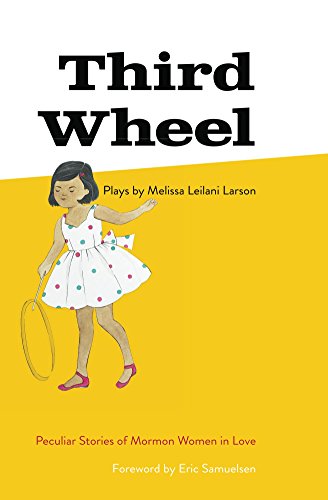
The first play, Little Happy Secrets, stars Claire, a student in Provo, Utah whose roommate Brennan starts dating a young man whom Claire is not particularly fond of. The second, Pilot Program, centers on Abigail, a Salt Lake City blogger, professor, and married woman in her 40s whose luck in the baby-making department has not been so lucky.
The first play, Little Happy Secrets, stars Claire, a student in Provo, Utah whose roommate Brennan starts dating a young man whom Claire is not particularly fond of. The second, Pilot Program, centers on Abigail, a Salt Lake City blogger, professor, and married woman in her 40s whose luck in the baby-making department has not been so lucky.
Thursday, June 1, 2017
Guess what, we're racist.
To my friends, enemies, general public, and specific readers of this blog: racism is everywhere. Seriously. Newsflash: Even you, reading this right now, are almost certainly a little racist.
Now, you're not alt-right. (idk, maybe you are, why are you on this blog?) You're accepting and want to believe in the best in people. You think that one alt-right twitter chick has taken it too far, and maybe you even shared Jana Riess' piece about how terrible she is. That's fine. She is terrible, and I think a lot of us can agree on that, but that's not why I'm here today.
 |
| No really. Everywhere. via |
Now, you're not alt-right. (idk, maybe you are, why are you on this blog?) You're accepting and want to believe in the best in people. You think that one alt-right twitter chick has taken it too far, and maybe you even shared Jana Riess' piece about how terrible she is. That's fine. She is terrible, and I think a lot of us can agree on that, but that's not why I'm here today.
Sunday, January 29, 2017
On the Muslim Ban: The Church Will Not Save Anyone
Last night I joined a few hundred people at the Salt Lake City airport to protest Donald Trump's ban of Muslims from a number of Middle Eastern countries. I won't delve into the technicalities of that here; information is easy to find. As things currently stand, an ACLU lawsuit led to the order being stayed nationwide late last night, but there are reports that the Department of Homeland Security may not respect the court. How that will resolve itself, and what the implications will be, remain to be seen.
Instead, I want to focus on the role the LDS church has played in this, or rather, not played. Across Facebook I've seen a number of progressive Mormons lament the church's passive role as hundreds of incoming immigrants and refugees nationwide have been detained without due process or sent away for the crime of being members of the wrong religion, of being born in the wrong country. On Saturday the Mormon Newsroom released a statement that reads:
Instead, this post is directed at members of the church who, like me, are horrified and infuriated by what's happening, but who, to some degree or another, still maintain some kind of faithful church affiliation. I mean this as a call to action and hope I don't come off as condescending, because I know a lot of you are doing a hell of a lot more than me. But as it relates to the church, I have this to say:
The church will not stand up.
The church will not join us.
The church will not save anybody.
Instead, I want to focus on the role the LDS church has played in this, or rather, not played. Across Facebook I've seen a number of progressive Mormons lament the church's passive role as hundreds of incoming immigrants and refugees nationwide have been detained without due process or sent away for the crime of being members of the wrong religion, of being born in the wrong country. On Saturday the Mormon Newsroom released a statement that reads:
"The Church of Jesus Christ of Latter-day Saints is concerned about the temporal and spiritual welfare of all of God's children across the earth, with special concern for those who are fleeing physical violence, war and religious persecution. The Church urges all people and governments to cooperate fully in seeking the best solutions to meet human needs and relieve suffering."Whether you regard this as adequate most likely depends on whether you believe there was a problem to begin with. My goal, however, is not to change anybody's mind about that. If fear and prejudice have rendered you incapable of empathizing with the innocent people being targeted by our government, if your beliefs do not compel you to welcome the immigrant and the refugee, I have nothing to say to you. Your religion is nothing to me.
Instead, this post is directed at members of the church who, like me, are horrified and infuriated by what's happening, but who, to some degree or another, still maintain some kind of faithful church affiliation. I mean this as a call to action and hope I don't come off as condescending, because I know a lot of you are doing a hell of a lot more than me. But as it relates to the church, I have this to say:
The church will not stand up.
The church will not join us.
The church will not save anybody.
We have to do it ourselves.
The church may eventually release a more specific or strongly worded statement, or it may not. It will continue its admirable charity efforts, and individual leaders may give inspiring talks next April. But the church will not join any protests. It will not take part in any resistance campaigns. It will not take an adversarial role against the United States government. It will not condemn the Trump administration and the politicians who enable it.
My point is not that the church should do any of these things. I'm long past trying to argue that, though I respect those who are trying. I'm not trying to say that anyone should disaffiliate or distance themselves; that is entirely a personal matter.
But if what we see bothers us, the Church of Jesus Christ of Latter-day Saints is not a vessel for change. We have to do it ourselves. We can protest, strike, call representatives, donate to good causes, and talk to people who are more involved in activism. We should enlist other Mormons wherever we can. I'm just beginning to try and be more than a keyboard warrior, and I have much more to learn than to teach.
But we cannot expect the church to lead us anywhere on this issue. We cannot expect it to follow. We cannot wait for it. We should not expect anything at all. The church will not save anyone. It's okay to be upset about that, but let's not stop there: let's find likeminded people and join them in doing something. These are dark days, but if I have faith in anything, it's that, despite my pessimism about the church and the country as a whole, we can still make a difference. We have to.
The church may eventually release a more specific or strongly worded statement, or it may not. It will continue its admirable charity efforts, and individual leaders may give inspiring talks next April. But the church will not join any protests. It will not take part in any resistance campaigns. It will not take an adversarial role against the United States government. It will not condemn the Trump administration and the politicians who enable it.
My point is not that the church should do any of these things. I'm long past trying to argue that, though I respect those who are trying. I'm not trying to say that anyone should disaffiliate or distance themselves; that is entirely a personal matter.
But if what we see bothers us, the Church of Jesus Christ of Latter-day Saints is not a vessel for change. We have to do it ourselves. We can protest, strike, call representatives, donate to good causes, and talk to people who are more involved in activism. We should enlist other Mormons wherever we can. I'm just beginning to try and be more than a keyboard warrior, and I have much more to learn than to teach.
But we cannot expect the church to lead us anywhere on this issue. We cannot expect it to follow. We cannot wait for it. We should not expect anything at all. The church will not save anyone. It's okay to be upset about that, but let's not stop there: let's find likeminded people and join them in doing something. These are dark days, but if I have faith in anything, it's that, despite my pessimism about the church and the country as a whole, we can still make a difference. We have to.
Monday, October 17, 2016
Uhh, We Have a Podcast, and It's Good
Hi everybody, Casey here. A few months back I wrote about the future of this blog, which is definitely not dead yet (we've even managed to pump out a few posts since!)
Meanwhile, our creative energies have been focused on other projects. First, Brooke and I are still running a movie discussion blog called Brooke and Casey at the Movies, which is updated periodically as we watch new and classic movies. It's fun, give it a read.
More recently, we started a podcast called Not Quite Right, in which we each select one topic for the other to explain to us (often badly), before we set each other straight. It's also great fun, You should listen to it immediately via iTunes, Google Music, or your podcast app of choice. Or give it a try right now: here's the latest episode, in which we discuss Metallica and CPR. We're just doing this for fun and for our own benefit, but hey, more listeners means we're more likely to stick with it. Enjoy!
Meanwhile, our creative energies have been focused on other projects. First, Brooke and I are still running a movie discussion blog called Brooke and Casey at the Movies, which is updated periodically as we watch new and classic movies. It's fun, give it a read.
More recently, we started a podcast called Not Quite Right, in which we each select one topic for the other to explain to us (often badly), before we set each other straight. It's also great fun, You should listen to it immediately via iTunes, Google Music, or your podcast app of choice. Or give it a try right now: here's the latest episode, in which we discuss Metallica and CPR. We're just doing this for fun and for our own benefit, but hey, more listeners means we're more likely to stick with it. Enjoy!
Sunday, August 7, 2016
Corianton, Mormons, and Sex
If you attend the mainstream LDS church and you go to Gospel Doctrine for Sunday School, then you're probably in Alma right now, close to the Corianton chapters. If you have no idea what I'm talking about, you can read Alma chapters 39 through 42 online or just keep reading for a brief overview.
In chapter 39, Alma lays out some serious allegations against his son, Corianton. Alma says that Corianton fled his missionary work with a harlot named Isabel and... *gasp* had sex with her. Alma goes on to explain that sexual sin is the worst kind of sin (okay, unless you're killing or denying the Holy Ghost), then he goes into a huge lesson on the resurrection and plan of salvation, and that's the way we usually talk about Corianton. He's Alma's kid who couldn't keep it in his pants.
In chapter 39, Alma lays out some serious allegations against his son, Corianton. Alma says that Corianton fled his missionary work with a harlot named Isabel and... *gasp* had sex with her. Alma goes on to explain that sexual sin is the worst kind of sin (okay, unless you're killing or denying the Holy Ghost), then he goes into a huge lesson on the resurrection and plan of salvation, and that's the way we usually talk about Corianton. He's Alma's kid who couldn't keep it in his pants.
Subscribe to:
Posts (Atom)